Platform Module
Purchasing
PO → Invoice execution (Buyer & Supplier)
A persona-driven purchasing workspace that guides the real-world flow from Purchase Order to invoice approval readiness. Buyers create and send POs, suppliers acknowledge and fulfill, buyers receive, and invoices can be matched back to what was ordered and received — reducing disputes before payment.
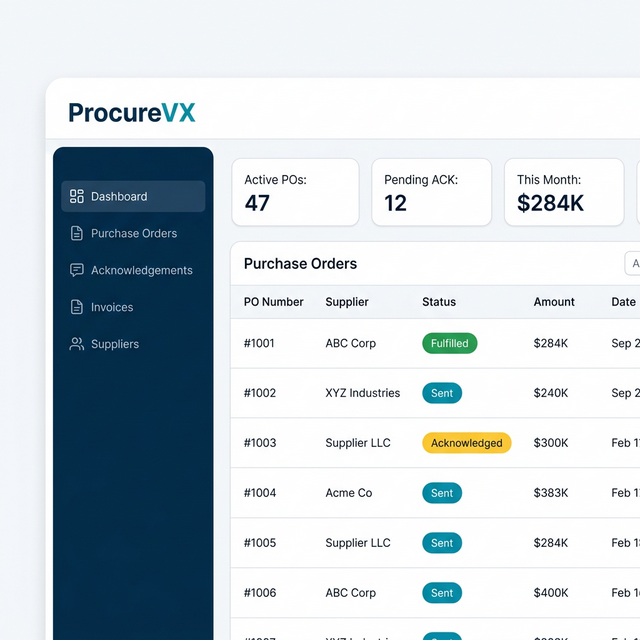
Common Purchasing Challenges — And How We Fix Them
Manual PO tracking in spreadsheets
Automated PO lifecycle with real-time status
Supplier acknowledgments via email
Built-in supplier portal for instant ACK/decline
3-way match takes days of manual work
AI-powered invoice matching in seconds
Capabilities
What Purchasing Can Do
Persona selection (Buyer / Supplier)
A simple entry gate that changes wording, menus, and work queues so buyers manage purchasing and suppliers respond to customer POs.
Guided PO creation (Draft → Sent)
Header → lines → totals → notes/attachments, with validation, “save as draft,” and a clear send action that creates a contractual/traceable event.
Supplier acknowledgement (accept / change / decline)
Acknowledge directly from the supplier inbox with reason capture. Buyer-facing acknowledgement status updates reduce back-and-forth and surprises.
Change management + resend with version history
When terms change (quantity, price, date), keep the negotiation loop structured: see differences, decide, revise, and resend with an auditable timeline.
Fulfillment signals + receiving protection
Support partial fulfillment and receiving so payment control is based on what actually arrived — including shortages, damage, or rejections.
Invoice readiness via matching (2-way / 3-way)
Make the downstream AP step easier: match invoice to PO (services) or PO+receipt (goods), highlight differences, and route exceptions for resolution.
Exception-first workflow
Late ship dates, partial shipments, price/quantity mismatches, and rejected goods are handled as clear exceptions with ownership and next actions.
End-to-End Flow
End-to-end lifecycle (PO → Invoice)
A demo-friendly, real-world sequence that mirrors how purchasing prevents disputes: agree on terms first, confirm delivery, then match the invoice to what was ordered and received before payment.
- Step 1
Persona selection (starting point)
Choose Buyer or Supplier to set the correct vocabulary, work queues, and available actions for the day.
- Step 2
Requisition / intake (optional)
Some teams start with an internal request. If your process doesn’t require requisitions, go straight to PO creation.
- Step 3
Buyer creates Purchase Order (Draft)
Buyer defines supplier, ship-to, line items, quantities, pricing, needed dates, and attachments. Validation keeps required fields and numeric rules consistent.
- Step 4
Buyer sends PO (Sent)
Send is the moment the PO becomes official and traceable — recorded with who sent it and when (and resendable when needed).
- Step 5
Supplier acknowledges (855)
Supplier accepts, proposes changes, or declines. Status updates are visible to the buyer with captured reasons when something changes.
- Step 6
Buyer reviews response + manages changes (860)
If changes are proposed, the buyer can accept, reject, negotiate, or revise and resend while keeping a versioned audit trail.
- Step 7
Fulfillment + receiving
Supplier ships or delivers services. Buyer records receiving (full or partial) and notes damaged/short/rejected quantities to prevent overpayment.
- Step 8
Invoice submitted + matching (2-way / 3-way)
Supplier invoices referencing the PO. Buyer matches Invoice ↔ PO (2-way) or Invoice ↔ PO ↔ Receipt (3-way). Matching drives approve vs hold/dispute workflows.
30 Seconds to Your "Aha" Moment
Watch how ProcureVX replaces fragmented tools with one unified platform — automatically, accurately, and at a fraction of the cost.
Platform Walkthrough
From PO to Payment in 30 seconds
Who It's For
Two personas. One shared source of truth.
Enter as Buyer or Supplier to get the right language, menus, lists, and actions. The workflows are designed to keep both sides aligned on item, quantity, price, and dates — before invoicing and payment.
Buyer (your company)
Create and send purchase orders, review supplier acknowledgements, confirm receiving, and prepare invoices for approval by matching back to PO and receipt.
- Create a PO with required terms (who/where/what/when) and save as Draft
- Send PO and track acknowledgement status (Pending → Accepted/Changes Proposed/Declined)
- Review “what changed” and accept/reject/revise + resend with audit history
- Confirm receiving (full/partial, damaged/rejected) to protect payment control
- Match invoice to PO (2-way) or PO+Receipt (3-way) and route exceptions
Supplier (vendor)
Respond to customer POs, communicate constraints early, fulfill shipments/services, and submit invoices that reference the PO to reduce holds and disputes.
- Triage new/updated POs in an inbox and open full PO detail with attachments
- Acknowledge: Accept / Propose Changes / Decline (with reason capture)
- Propose realistic ship dates, quantities, or pricing when needed
- Support fulfillment with shipment signals (optional ASN/packing documentation)
- Create/submit an invoice from the PO to reduce billing errors
Expected Outcomes
- Fewer invoice disputes because PO terms and receiving are visible and traceable
- Faster approvals with 2-way/3-way match readiness and exception-first routing
- Clear accountability with auditable sent/acknowledged/changed events
- Better supplier collaboration through structured acknowledgements and reasons
Role-based access control (RBAC) + clean auditability
- Create/edit PO drafts (header + lines + attachments)
- Send/resend POs with timestamped audit events
- Approve supplier proposed changes or revise/resend
- Record receiving outcomes (full/partial/damaged/rejected)
- Initiate match review and route invoice exceptions (where enabled)
- View received POs and attachments
- Acknowledge: accept / propose changes / decline (with reasons)
- Provide ship dates and fulfillment constraints
- Create invoice from PO and submit (where enabled)
- Maintain an auditable communication trail tied to the PO
Acceptance criteria highlights
- Buyer can create a PO with required fields (supplier, ship-to, lines, quantities, pricing, needed date)
- PO supports Draft save and strong validation (required fields and numeric rules)
- Send action records an auditable “Sent” event (who/when) and supports resend
- Supplier can Accept / Propose Changes / Decline and must capture a reason for changes/decline
- Buyer can clearly see “what changed” and accept/reject/revise + resend
- All acknowledgements and revisions are traceable with timestamps and actors
- Receiving can be recorded against PO lines (full/partial), including damaged/short/rejected quantities
- Invoice matching concept supports 2-way (PO↔Invoice) and 3-way (PO↔Receipt↔Invoice) displays
- Mismatches can be flagged and routed as hold/disputed/needs review
FAQ
Common Questions About Purchasing
Is Purchasing only about POs, or does it help with invoices too?
Purchasing is the upstream control layer. By capturing acknowledgements and receiving against the PO, invoices can be matched to what was ordered and received — reducing holds and disputes before payment.
Do suppliers need EDI to participate?
No. Suppliers can collaborate via portal workflows today and add EDI/API later (850/855/856/860 and invoice integrations where applicable).
What happens when a supplier can’t meet the date or price?
Suppliers can propose changes with a reason. Buyers can accept, reject, or revise and resend — and the system keeps a versioned audit trail of what changed and when.
How do partial shipments and partial receiving affect matching?
Receiving can be recorded by line and quantity. Matching can then compare what was ordered, received, and billed so overbilling is flagged and routed for review.